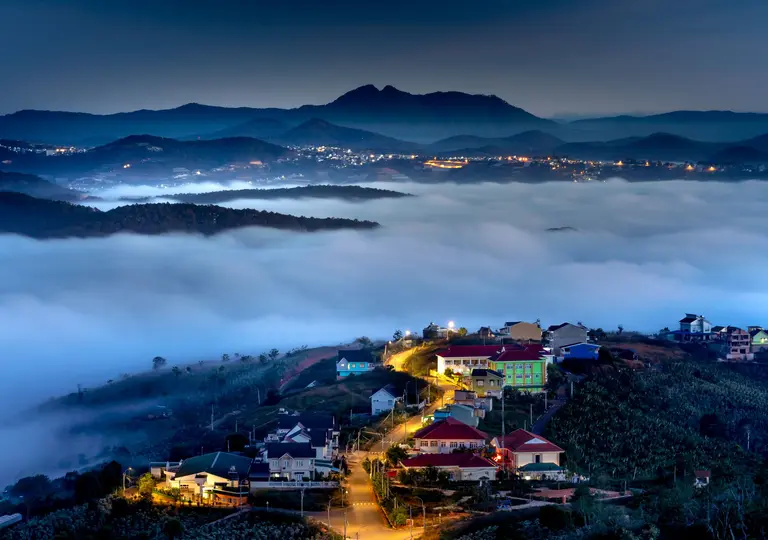
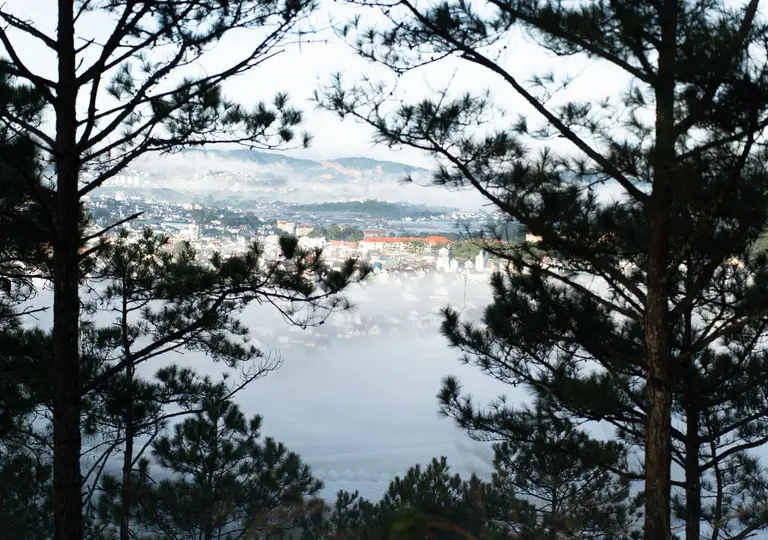
Da Lat food is cold-weather food in a country that mostly doesn't have cold weather. Everything is hot, brothy, or grilled in front of you over coals. That's the through-line, and once you see it, the city's dishes stop looking like a random list.
Let me be straight about one thing first, though. Da Lat isn't a food destination the way Hoi An or Hue are. There's no long canon of famous dishes here. What there is instead is a handful of things that exist in this city and nowhere else, plus the best vegetables in Vietnam — because this is where the country grows them.
Here's what to actually eat, roughly what it costs, and where to go for it. For the rest of the city, start with my Da Lat travel guide.
The Short Version: What to Eat in Da Lat
| Dish | What it actually is | Roughly | When |
|---|---|---|---|
| Banh mi xiu mai | Pork meatballs in hot broth, with a baguette to dip. Not a sandwich | 25,000–35,000 ₫ | Breakfast, early |
| Banh trang nuong | Rice paper grilled on charcoal with egg and toppings | 15,000–30,000 ₫ | Evening, standing up |
| Lau ga la e | Chicken hotpot with a peppery wild basil leaf | 250,000–400,000 ₫ for two | Dinner, cold nights |
| Banh can | Little rice-flour cakes with quail egg, cooked in a clay mold | 30,000–50,000 ₫ | Breakfast or late afternoon |
| Banh uot long ga | Steamed rice sheets with chicken and offal | 35,000–50,000 ₫ | Lunch |
| Nem nuong | Grilled pork you roll yourself in rice paper and herbs | 50,000–80,000 ₫ | Any time |
| Sua dau nanh | Hot soy milk, from a street of stalls that only sell that | 10,000–15,000 ₫ | After dinner |
| Kem bo | Avocado puree under coconut ice cream | 25,000–40,000 ₫ | Afternoon |
Those are the eight. Everything else you'll be offered in Da Lat is either grown here, drunk here, or sold to tourists here, and I'll get to all three.
Banh Mi Xiu Mai: The One That Confuses Everyone

If you eat one thing in Da Lat, eat this, and know what's coming so you don't look as puzzled as I did the first time.
Banh mi xiu mai (bánh mì xíu mại) sounds like a sandwich. Everywhere else in Vietnam it more or less is one. In Da Lat it arrives as a small bowl of clear, faintly sweet pork broth with two or three meatballs in it, a slick of chili oil, scallions on top, and a baguette on the side. You tear the bread and dip it. That's the dish.
It's a breakfast built for a cold morning, and it is genuinely one of my favorite things to eat anywhere in the country. Around 25,000 to 35,000 ₫, and I've eaten the same bowl four mornings in a row without getting bored of it.
Hoang Dieu street is the traditional cluster for it — several places within a few doors of each other, all doing the same thing slightly differently. Go early. These are breakfast businesses in the real sense: they open around 6:30, and by ten the good ones have sold what they made and closed the shutter.
Banh Trang Nuong: The One Da Lat Invented

Banh trang nuong (bánh tráng nướng) is the dish this city gets credited with, and it's the one you'll see called "Vietnamese pizza" on every blog. The name is lazy but not wrong.
A sheet of rice paper goes onto a small charcoal grill. The vendor cracks an egg onto it and spreads it thin with the back of a spoon, then adds dried shrimp, scallions, pork floss, sometimes cheese or a sliced sausage, and a stripe of chili sauce. Two minutes, a fold, and it's handed to you in paper. Fifteen to thirty thousand dong.
Eat it standing next to the coals while it's still too hot. It doesn't travel and it doesn't keep — the whole point is the rice paper going crisp, and ten minutes in a bag ruins that.
One thing worth knowing. The version at the night market is fine, and it's also the version everyone has. The better ones are the small evening carts in ordinary neighborhoods, where one woman has been making the same thing on the same corner for years and there's a short queue of teenagers. If you're asked how much chili you want, "một ít" — a little — is the safe answer until you know.
Hotpot: The Actual Reason to Be Cold

Hotpot is what Da Lat does better than anywhere in southern Vietnam, for the obvious reason. Sitting around a boiling pot makes sense at fifteen degrees in a way it never does in Saigon.
La e chicken hotpot
The one to order is lẩu gà lá é — chicken hotpot with lá é, a wild leaf in the basil family that tastes peppery and slightly citrusy and doesn't really have an English name. It came up from Phu Yen originally but Da Lat has thoroughly adopted it, and it's now the local dinner.
You get a pot of broth with chicken, a plate of the leaves, noodles, and a dipping bowl of salt, chili and lime. The leaves go in at the last second and come out almost immediately; overcook them and they turn bitter and gray, which is exactly what I did the first time while somebody at the next table watched with visible pity.
A pot for two runs somewhere around 250,000 to 400,000 ₫ depending on the place, and it's easily enough for three if you add noodles.
Beef and goat hotpot
Lẩu bò and lẩu dê are the other two you'll see, both heavier and both good. Goat is the one to order if it's genuinely cold and you've been walking all day.
Whichever you pick, order more vegetables than you think you need. This is the one city in Vietnam where the greens are the best thing on the table — Da Lat grows most of the country's vegetables, and a plate of them here is a different product from the same plate at sea level.
Practical note: hotpot restaurants here are big, loud, and slammed on weekends and holidays, when half of Saigon drives up. Eat at six, or reserve.
Banh Can and Banh Uot Long Ga
Two dishes eaten off tiny plastic stools, both cheap, both worth going out of your way for.
Banh can (bánh căn) is a dish of little rice-flour cakes cooked in a heavy clay mold with a dozen round wells in it, each one cracked with a quail egg. They come off crisp underneath and soft on top, and you get them with scallion oil and a bowl of fish sauce that usually has a couple of pork meatballs sitting in it. Thirty to fifty thousand dong for a plate. It's from Ninh Thuan down on the coast, not from here, but it's been a Da Lat breakfast for long enough that nobody's arguing.
Banh uot long ga (bánh ướt lòng gà) is the more local of the two and needs a warning label. Soft steamed rice sheets, shredded chicken, herbs, fried shallots, a little sauce — and chicken offal, which is the "lòng" part and the reason many visitors put the menu down. If that's not for you, ask for it with just the meat and you'll be understood. Done well it's one of the best lunches in the city. Tang Bat Ho street near the market is where I'd look.
Nem Nuong: The Import That Stuck

Nem nướng is originally from Nha Trang on the coast, and Da Lat makes no claim to it. It's here because it's good and because it works in the cold.
Grilled seasoned pork comes to the table on skewers or as small patties, with a tray of rice paper, lettuce, herbs, cucumber, pickled vegetables, sometimes a crisp fried spring-roll wrapper, and a thick peanut-and-fermented-soy dipping sauce. You build the rolls yourself. Nobody will judge how badly the first two come out.
Reckon on 50,000 to 80,000 ₫ a person. It's the easiest thing on this list to eat with someone who's nervous about Vietnamese food, because you can see every ingredient before it goes in.
The Sweet Things, All of Them Served Warm
Hot soy milk. There is a street near Da Lat Market — Tang Bat Ho — where the stalls sell almost nothing but sữa đậu nành, hot, in a glass, sometimes with a crème caramel or a little pastry alongside. Ten or fifteen thousand dong. Locals go after dinner and sit there in jackets, and it is the single most Da Lat thing you can do. Do not skip this because it sounds boring.
Kem bo. Avocado ice cream, and don't wrinkle your nose at it. It's a cup of cold, smooth, barely sweet avocado puree with coconut ice cream on top and sometimes toasted coconut. Da Lat grows very good avocados and this is the best use of them. The place everyone means is on Nguyen Van Troi; there'll be a crowd of Vietnamese teenagers outside and no English sign.
Che, served hot. Chè is the sweet-soup family you'll find all over Vietnam, usually iced. Up here they serve it warm — beans, tapioca, coconut milk, sometimes ginger — and it makes far more sense this way.
What Actually Grows Here

Da Lat is Vietnam's vegetable basket, and it's worth understanding what that means for your meals. The salads are real. The greens in your hotpot were picked a few kilometers away. This is not a small thing in a country where vegetables often arrive tired.
Strawberries. The thing Da Lat is best known for growing, and the thing most often faked. Peak season is roughly November to April. Here's the honest version: a lot of the "Da Lat strawberries" sold from roadside stands and tourist stops aren't from Da Lat at all. Local fruit tends to be smaller, paler on the shoulders, irregular, and it bruises quickly, because it hasn't traveled. Buy at a farm you've driven to, or at the market, and be suspicious of anything unusually large, uniform and cheap. Jam, dried slices and strawberry yogurt are all good and travel better than the fruit.
Artichoke. Atisô is genuinely a Da Lat crop and shows up two ways: as a tea sold in every souvenir shop, and — much better — stewed for hours with pork ribs into a soup that tastes like nothing else in Vietnamese cooking. If you see canh atisô hầm sườn on a menu, order it.
Persimmon, avocado, coffee. Persimmons (hồng) in autumn, sold fresh or dried into chewy slices. Avocados year-round. And coffee, which deserves its own section below.
If produce is part of why you're coming, timing matters. My month-by-month guide to the best time to visit Da Lat lines up the seasons.
Coffee: Good Beans, One Tourist Trap
Lam Dong, the province Da Lat sits in, grows more coffee than anywhere else in Vietnam. Most of that is robusta from lower down, but the hills southeast of the city around Cau Dat are high enough for arabica, and that's what makes the coffee scene here different from Saigon's.
Order it the local way at least once: a phin filter dripping into a glass over condensed milk, or cà phê sữa đá if you want it iced. In a town this cold I usually want it hot, which is not something I ever say at home.
Now the trap. Weasel coffee — cà phê chồn, sold as civet coffee — is offered at nearly every farm stop and souvenir shop on the tour circuit, at many times the price of ordinary beans. Most of what's sold under that name isn't what it claims to be, and the version that is real often involves caged animals. I skip it, and I'd suggest you spend the same money on good arabica from a roaster in town instead.
The farm-stop coffee tasting is still interesting the first time. Just go in knowing it's a shop.
What's Overrated
Someone has to say it.
- Night market food. Worth one evening for the atmosphere — the steps, the coals, the crowd, the cold. But it's the tourist-facing version of everything on this page, prices drift upward, and the same three or four stalls get photographed on repeat. Eat there for the experience, then eat properly somewhere else.
- Da Lat wine. Vang Đà Lạt exists, and people buy it because a bottle of Vietnamese wine is a good story. It is a souvenir, not a wine. I've done my duty with it more than once and I've never gone back for a second glass.
- Weasel coffee. See above.
- Western restaurants. There are decent ones. But paying four times the price for a mediocre burger in a city that does broth this well is a strange way to spend an evening.
- Anywhere with a photo menu and a man outside waving you in. Universal rule, but it holds especially near the lake.
Where Locals Actually Eat

Central Da Lat is small, which is the good news — most of this is walkable if you're staying near the market or the lake. My guide to where to stay in Da Lat covers which areas put you inside that circle.
The streets worth knowing:
- Hoang Dieu — banh mi xiu mai in the morning, several places in a row.
- Tang Bat Ho — hot soy milk in the evening, banh uot long ga during the day. Close to the market.
- Nguyen Van Troi — the avocado ice cream, plus general evening eating.
- Phan Dinh Phung and the alleys off Ba Thang Hai — ordinary local restaurants, no English, no photos on the wall. This is where I end up most nights.
My rule of thumb here is the same as anywhere in Vietnam, and it has not failed me yet. If the menu has photographs and English, you're paying the visitor rate. If there's a queue of people on plastic stools at seven in the morning and no menu at all, join it and point at what the person ahead of you got.
One Day of Eating in Da Lat
If you want it as a plan rather than a list, this is my day:
- 7:00. Banh mi xiu mai on Hoang Dieu. Coffee after, not before.
- 11:30. Banh uot long ga or banh can near the market.
- 15:00. Kem bo on Nguyen Van Troi, or a cafe with a view and a phin filter.
- 18:30. La e chicken hotpot, with double the vegetables. Go early or you'll wait.
- 21:00. Banh trang nuong from a neighborhood cart, then hot soy milk on Tang Bat Ho in a jacket.
That's one full day and it covers six of the eight dishes at the top of this page. Two days gets you all of them without hurrying — see my guide on how many days you need in Da Lat to see how eating fits around everything else.
And if you're driving out to the falls, eat lunch in Nam Ban rather than bringing snacks. The stop is already on the route in my guide to Da Lat's best waterfalls.
Continue Planning Your Da Lat Trip
- Time your trip with the month-by-month Da Lat weather guide.
- Work out how long to stay with how many days you need in Da Lat.
- Choose a base in where to stay in Da Lat.
- Plan a day out with Da Lat's best waterfalls.
- Browse all Vietnam travel tips and practical guides.